Nakhon Si Thammarat: Southern Thailand without the Tourists (Travel Guide 2026)
There is one province in the south that we keep coming back to, and it is not an island. Nakhon Si Thammarat lies on the Gulf of Thailand, between Surat Thani and Songkhla, and most travellers drive straight past it on their way to Koh Samui or Krabi. Their loss, and good news for anyone who does stop. Here you will find one of the oldest cities in Thailand, a temple that has been on the UNESCO World Heritage List since July 2026, a mountain village with the cleanest air in the country and a coastline with miles of beach where you meet more fishermen than other tourists.
This is not a guide like our other destination guides. Nakhon Si Thammarat has no hundreds of hotels and no endless list of tours, and that is exactly why we love going there. We stayed in the city twice ourselves, have spent a week several times with family who own a house on the beach, and saw the pink dolphins leaping out of the sea. Below you will read what we would recommend if you asked us where in southern Thailand you can still travel in a truly local way.
Published on 14 November 2026.
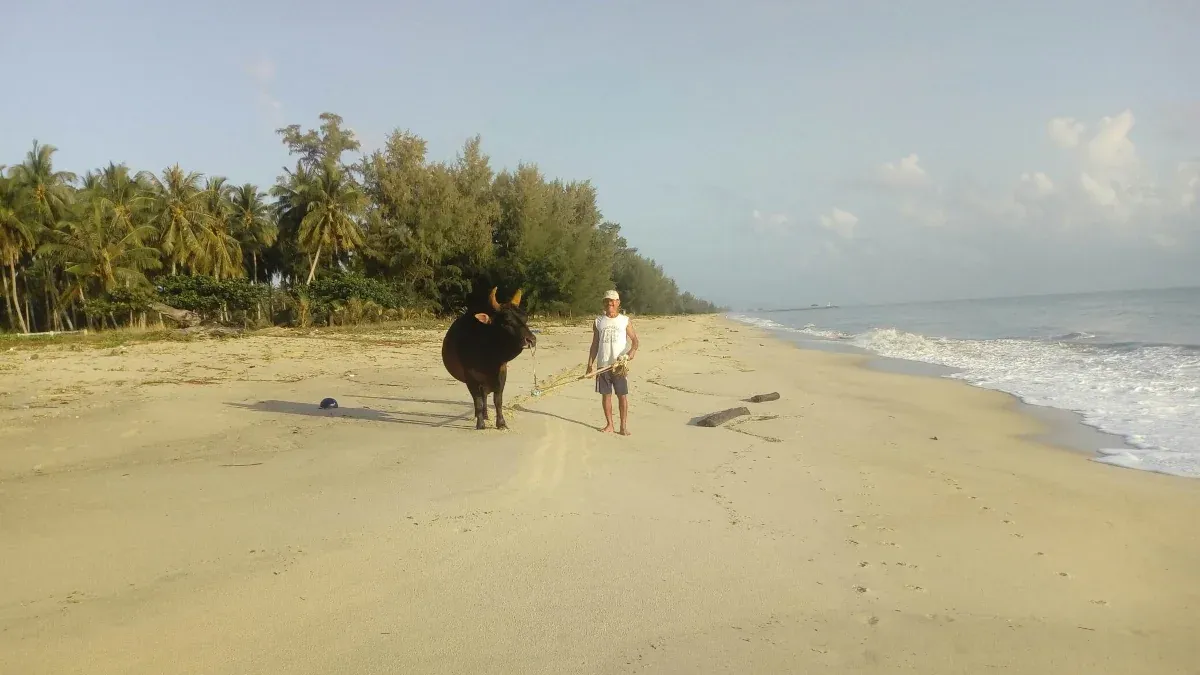
Table of ContentsToggle Table of Contents
- Why Nakhon Si Thammarat?
- Nakhon Si Thammarat City: What to See?
- Kiriwong: Mountains and Rivers
- The Beaches: Miles without High-Rises
- Excursions in Nakhon Si Thammarat
- A Sample One-Week Route
- Best Time to Visit Nakhon Si Thammarat
- How to Get to Nakhon Si Thammarat?
- Frequently Asked Questions about Nakhon Si Thammarat
Why Nakhon Si Thammarat?
Nakhon Si Thammarat, which Thais simply call “Nakhon” or “Mueang Khon”, was already an important trading and religious city more than a thousand years ago, long before Bangkok existed. From here Buddhism spread across the south, and you can still see that today: the city revolves around the great temple, there are more monasteries than hotels and the rhythm of the day is set by markets, coffee houses and temple festivals.
On 25 July 2026 Wat Phra Mahathat Woramahawihan, the city’s great temple, was inscribed as a UNESCO World Heritage Site. It is Thailand’s ninth World Heritage Site and the first in the south. More Thai visitors have come since then, but you still see few foreign tourists.
What makes the province so special to us is the combination. In one trip you get:
- Culture in the city: the World Heritage temple, the old city wall, shadow puppet theatre and a coffee house from 1942.
- Mountains in Kiriwong: a village at the foot of the highest mountain in southern Thailand, with rivers, fruit orchards and batik.
- Beach on the Gulf: between Khanom and the city, dozens of kilometres of coast without high-rises, with fishing villages and the pink dolphins of Khanom.
Local and authentic are words that travel guides use far too often, but here they are true. Little English is spoken, menus are often only in Thai and people are genuinely happy that you are there.
Nakhon Si Thammarat City: What to See?
The city is long and narrow: the old centre with the temple and the city wall lies in the south, the modern centre with the station and the shops further north. The hotels are spread across the city. By Grab or taxi you get from one part to the other in ten to fifteen minutes.
Wat Phra Mahathat Woramahawihan
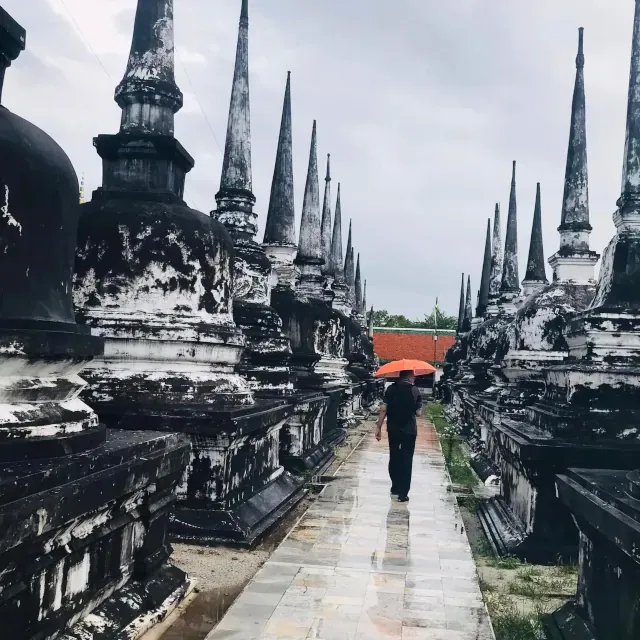
The reason you come to Nakhon Si Thammarat. The huge white chedi with its golden spire can be seen from miles away and, according to tradition, holds a relic of the Buddha. Around the chedi stand dozens of smaller stupas, a covered gallery full of Buddha statues and a small museum with offerings left by pilgrims over the centuries. It is not a museum temple: people pray here every day, and on the major Buddhist holidays thousands of people carry a long orange cloth in procession to the chedi to wrap it. That ceremony, Hae Pha Khuen That, was one of the reasons for the UNESCO recognition.
Practical: Open daily from about 08:00 to 16:30, admission is free. A small voluntary donation for the upkeep of this historic and sacred Buddhist temple complex is appreciated, though. Cover your shoulders and knees, and take off your shoes in the prayer halls. Come early in the morning, when it is still cool and you see the monks.
The Old City Wall and the North Gate
Of the wall that once surrounded old Nakhon, a section still stands on the north side of the old centre, with the restored city gate (Pratu Chai Nuea) and a stretch of the ramparts. It is not a major sight, but it is a nice place for a short stroll, and in the evening it is the backdrop of the night market.
Shadow Puppet Theatre: Nang Talung
Nakhon Si Thammarat is the birthplace of nang talung, the shadow puppet theatre of southern Thailand: figures of cut and painted buffalo hide, moved behind a lit screen by a single puppeteer (the nai nang) who does all the voices, accompanied by a small band. The performances are full of humour and local gossip, and the audience joins in loudly.
A fun way to see it is an evening at Krua Nai Nang, a large restaurant with an open, covered dining hall where you eat southern Thai dishes and on some evenings watch a shadow puppet performance. Note: southern food is spicy, so feel free to ask for “mai phet” (not spicy). Ask your hotel whether there is a show that evening. If you want to see how the puppets are made, go during the day to the house museum of puppet maker Suchart Subsin in the old centre, where the family still cuts the puppets by hand.
Kopi 1942: Coffee as in 1942
Every city in the south has its coffee houses, but Kopi (also Kopee) is an institution. It was founded in 1942 by a Hainanese immigrant and is now run by the third generation. The interior is old-fashioned Chinese, with white accents, marble tables and old photos, and locals call it “the living room of Nakhon” for good reason. Order a strong coffee with condensed milk, roti or dim sum, and watch the city wake up.
Practical: The best-known branch is next to the Provincial Hall (Sala Klang). Open daily from about 06:00 to 21:00, although hours can differ per branch.
The Night Market by the City Wall
In the evening, from about 17:00 to 21:00, the Kamphaeng Muang Khon market sets up by the old city wall: stalls with southern curries, grilled fish and chicken, khanom jeen (rice noodles with curry), sweets and fresh fruit shakes. Two of you can eat here for a few hundred baht, among local families.
Where to Stay in Nakhon Si Thammarat City?
Plan at least two nights in the city. We stayed at The Twin Lotus Hotel twice ourselves and it is a good hotel: large, comfortable, with a pool, and the best address in town. Other good choices are the modern Pura Nakhon Hotel in the north of the city, the small Navakitel Design Hotel and the quiet Bunprasop Garden Hotel with a garden and free bicycles.
Want to know more? In our guide to hotels in Nakhon Si Thammarat we list all the hotels in the city, in Kiriwong and on the beach.
Kiriwong: Mountains and Rivers
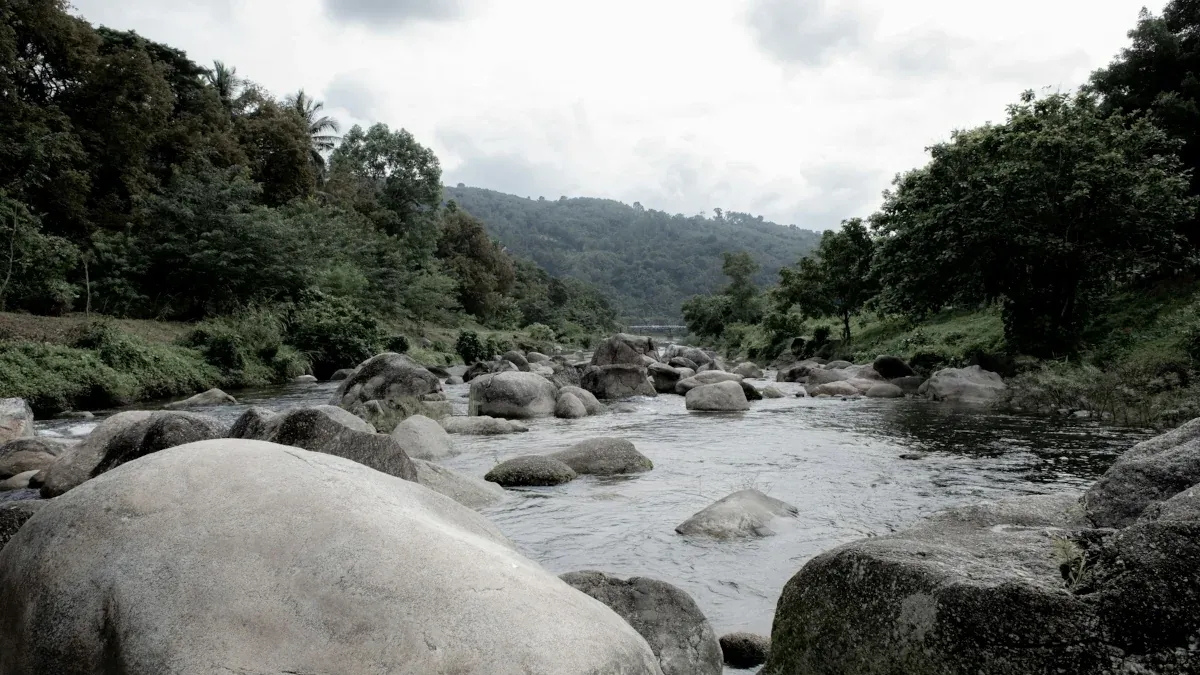
Half an hour’s drive from the city lies Ban Kiriwong (also Khiriwong), a village in a green valley at the foot of Khao Luang, at 1,835 metres the highest mountain in southern Thailand. A clear river runs through the village, the houses stand among orchards full of durian, mangosteen and rambutan, and in Thailand Kiriwong is known as the village with the cleanest air in the country. You come here for mountains, rivers, pure air and above all peace and quiet.
During the day you can walk along the river, swim in the natural pools and visit the orchards. A must is the Ban Khiriwong Natural Batik Group, a cooperative of villagers who make batik with natural dyes from leaves, bark and fruit of the trees around the village. You can watch, buy and paint a cloth yourself. In 2025 the Thai government named Kiriwong one of the ten best communities for cultural tourism.
How to get there? Ask your hotel in the city for a transfer to Kiriwong. They know taxi drivers who are happy to make the trip. Stay one or two nights; you can sleep at the small Passion Resort Kiriwong on the edge of the village.
The Beaches: Miles without High-Rises
Between Khanom in the north and the city of Nakhon Si Thammarat in the south, the coast runs for more than a hundred kilometres along the Gulf of Thailand. You will find many beaches there, often miles long, without high-rises and without hordes of tourists. The best-known places are Khanom, with its bays and the pink dolphins, Sichon and Tha Sala; in between lie fishing villages, coconut palms and endless sand.
Our Favourite Beach
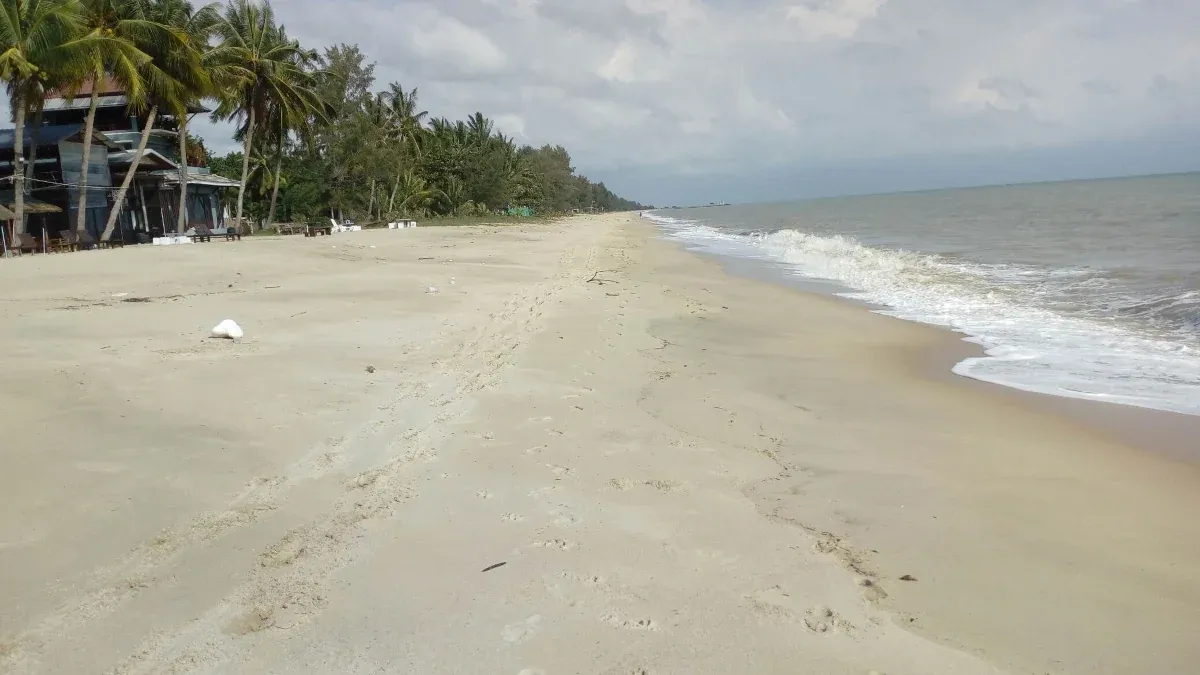
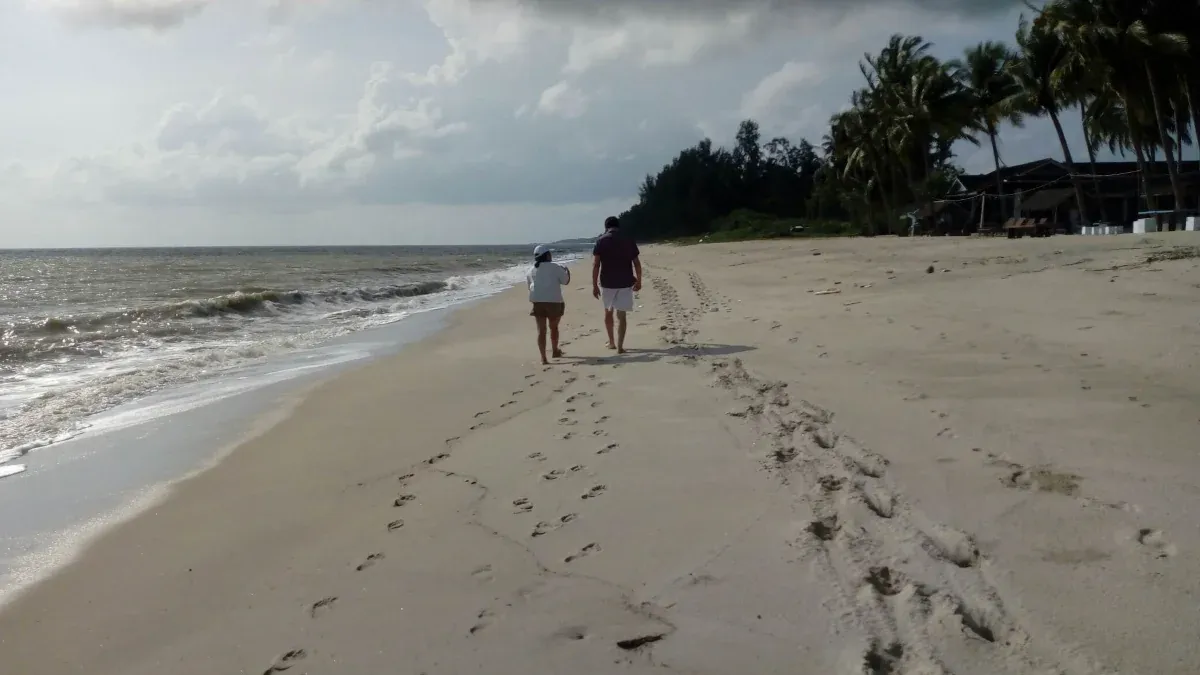
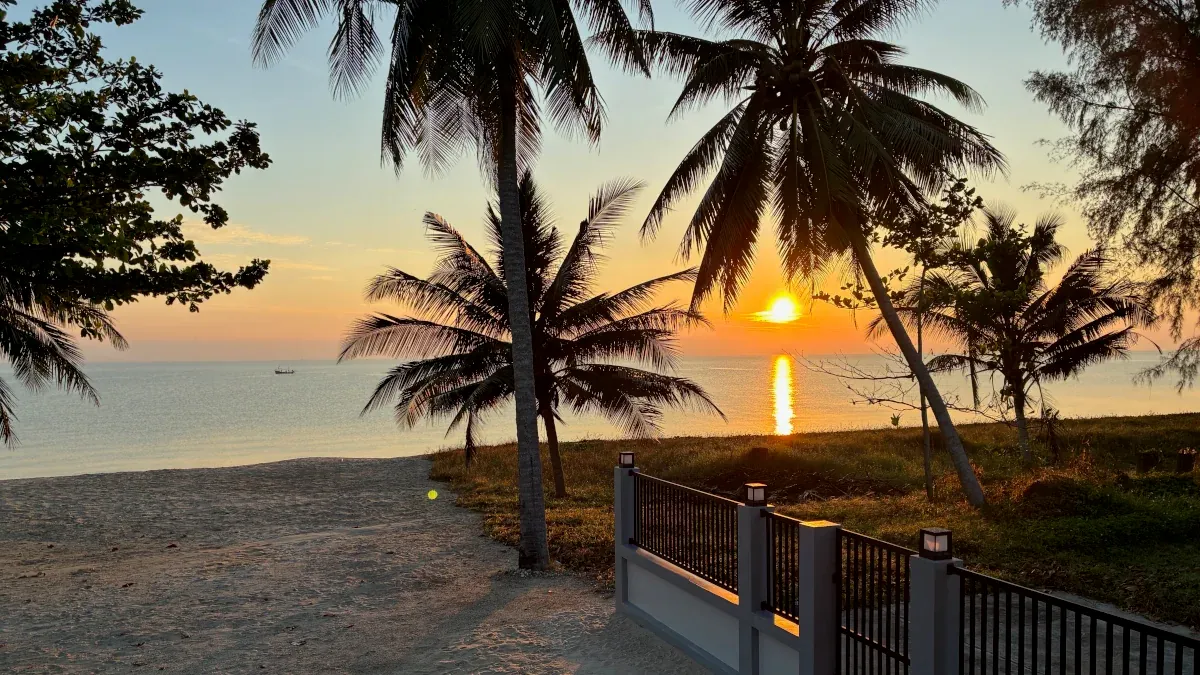
Our favourite beach lies halfway between Sichon and Tha Sala, about an hour’s drive north of the city. Family of ours has a house on the beach, and we have spent a week there several times. It is a beautiful beach, miles long, that you have practically all to yourself. In the morning you walk along the sea for an hour without meeting anyone, apart from a few fishermen fishing from the beach, and in the evening local Thai families have picnics on the sand. If you want a week of doing nothing, this is the place.
Where to Stay on Our Favourite Beach?
- Loma Beach Resort: Our family’s house is not far from this resort, and we have visited it and eaten there ourselves. Loma is run by Warren, a New Zealander who has lived in Thailand for more than thirty years, and his Thai wife. It is a cosy, family-style resort with a friendly crew that gives good service. The restaurant serves good Thai dishes and also tasty pizzas; we have eaten both ourselves.
- Seava Beach: A newer, somewhat more luxurious resort on the same beach, with an outdoor pool, restaurant and bar.
Want to know more? You will find both resorts, with their ratings and links, in our guide to hotels in Nakhon Si Thammarat.
Excursions in Nakhon Si Thammarat
From the beach, the best trips in the province are a short distance away:
- The pink dolphins of Khanom: Off the coast of Khanom lives a group of Indo-Pacific humpback dolphins, which turn pink as they age. You hire a boat from the pier at Ao Talet or from Laem Prathap; go early in the morning for the best chance. We have seen them ourselves, and it is truly a wonderful sight to watch the dolphins leap out of the sea.
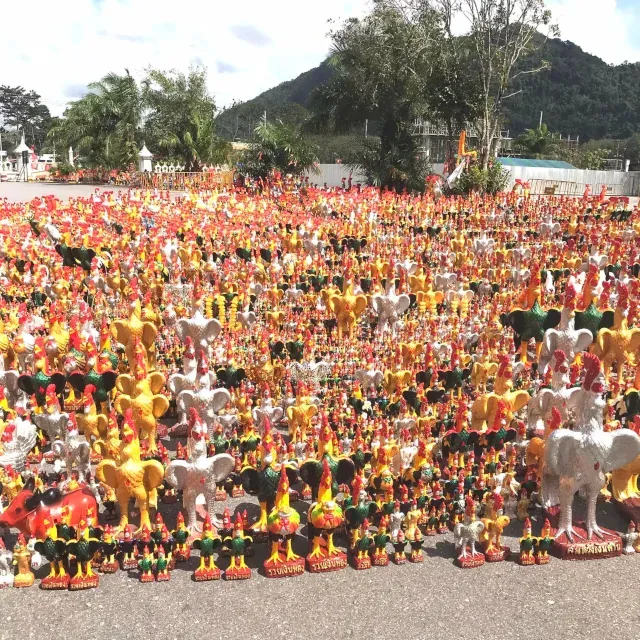
- The chicken temple Wat Chedi (Ai Khai): A temple in Sichon with thousands of statues of chickens and roosters, as thanks to the spirit of the boy Ai Khai. Bizarre, colourful and very Thai. We have been there ourselves.
- The viewpoint on the Khanom-Sichon coast road: A stunning coastal road over Khao Phlai Dam hill, with a viewpoint over the bays halfway along.
- BOTA Sky Tower: An observation tower of about 25 metres with a wooden walkway over the treetops, in the botanical garden of Walailak University in Tha Sala, close to our favourite beach. We climbed it ourselves.
- Kiriwong and the batik cooperative: Also possible as a day trip from the city.
Want to know more? In our guide to excursions in Nakhon Si Thammarat you can read how to get there, what it costs and when it is best to go.
A Sample One-Week Route
This is how we would do it ourselves:
| Days | Where | What |
|---|---|---|
| Day 1-2 | Nakhon Si Thammarat City | Wat Phra Mahathat, city wall, Kopi 1942, night market, shadow puppet theatre |
| Day 3-4 | Kiriwong | River, orchards, batik cooperative, peace and quiet |
| Day 5-7 (or longer) | The beach between Sichon and Tha Sala | Beach, Wat Chedi Ai Khai, coast road to Khanom, pink dolphins |
From the beach near Khanom it is a short drive to the Donsak ferry to Koh Samui, so you can easily combine this route with a few days on the island.
Best Time to Visit Nakhon Si Thammarat
Nakhon Si Thammarat lies on the east coast of the south and follows the same weather pattern as Koh Samui: the rainy season here is not in summer, but from about October to December, with November as the wettest month and occasional flooding. From February to August it is usually dry and sunny, including the months when it rains on the Andaman coast (Phuket, Krabi). Read more in our guide to the best time to travel to Thailand.
How to Get to Nakhon Si Thammarat?
Flying
The fastest way is by plane: AirAsia flies several times a day in about 1 hour and 15 minutes from Don Mueang in Bangkok to Nakhon Si Thammarat (Nok Air and Thai Lion Air also fly this route). The airport lies north of the city; at the exit, taxis wait to take you to the centre. For your international flight, see our page on flight tickets to Thailand.
The Night Train
If you have more time, the train is a good option. It is an experience in itself. Two night trains run daily from Krung Thep Aphiwat station in Bangkok to Nakhon Si Thammarat:
| Train | Departs Bangkok | Arrives Nakhon Si Thammarat | Classes |
|---|---|---|---|
| Express 85 | 19:50 | 09:55 | 1st class sleeper cabin, 2nd class sleeper berth (air-con), restaurant car |
| Rapid 173 | 20:10 | 10:20 | 2nd class sleeper berth (air-con), 2nd and 3rd class seat (fan), no 1st class |
And back:
| Train | Departs Nakhon Si Thammarat | Arrives Bangkok |
|---|---|---|
| Express 86 | 16:00 | 06:10 |
| Rapid 174 | 16:30 | 06:45 |
The journey takes about 14 hours. If you want your own lockable cabin, choose train 85: train 173 has no 1st class. A 2nd class sleeper berth on train 173 costs around 715 baht (upper) or 785 baht (lower); prices are subject to change. Earplugs and an eye mask are recommended, because the air conditioning is cold and the lights never go fully off. Bring a cardigan too. How to book train tickets in Thailand online is explained in our article on the night train to Chiang Mai; it works exactly the same for the south. Timetables change, so check the times shortly before you travel.
Frequently Asked Questions about Nakhon Si Thammarat
Is Nakhon Si Thammarat worth visiting?
Yes, especially if you already know Thailand a little and want something different from the well-known islands. You get a World Heritage temple, a mountain village and empty beaches, without mass tourism. It is our favourite province in the south.
How many days do you need?
At least two nights for the city, one or two nights in Kiriwong and then as many beach days as you like. With a week you see the highlights; we ourselves always stay a week on the beach.
Do people speak English there?
Not much. In the hotels and at Loma Beach Resort you will manage fine, but at markets and in local restaurants a translation app helps. That is part of the charm.
Can you combine Nakhon Si Thammarat with Koh Samui?
Yes. The ferry from Koh Samui arrives in Donsak, close to Khanom, and from there you reach the beaches of Khanom and Sichon in half an hour to an hour. A great combination is first a week on Koh Samui and then a week of peace on the coast of Nakhon Si Thammarat, or the other way round.
Is Wat Phra Mahathat a World Heritage Site?
Yes. Since 25 July 2026 Wat Phra Mahathat Woramahawihan has been on the UNESCO World Heritage List, as Thailand’s ninth World Heritage Site and the first in southern Thailand.