
Money and payments in Thailand: the short version
Yes, you need cash in Bangkok. Cards work in malls, hotels and bigger restaurants, but street food, markets, tuk-tuks and many small restaurants are cash only. Each ATM withdrawal costs 250 baht with a Visa card and 350 baht with a Mastercard, so take out larger amounts at once and always choose “Without Conversion”. You get the best exchange rate at bureaux like SuperRich, not at your hotel.
One of the most practical questions to ask before your trip to Thailand: what about money and payments? In this article, we explain everything you need to know about the Thai baht, where best to exchange money, how to manage cash versus debit cards, and all the handy tips to avoid paying too much in transaction fees.
The Thai baht: what do you need to know?
The official currency of Thailand is the baht, abbreviated as THB or denoted by the symbol ฿. The exchange rate fluctuates, but on average you get around 37–38 baht for 1 euro. Fortunately, this makes converting fairly straightforward: divide by 40 for a quick rough estimate, or multiply baht amounts by 0.025 for a more accurate figure in euros.
Other currencies:
For 1 USD you get about 32 baht.
For 1 GBP you get about 43 baht.
For 1 CAD you get about 23 baht.
For 1 AUD you get about 23 baht.
For 1 NZD you get about 19 baht.
Banknotes You will come across the following banknotes:
- 1,000 baht (beige/grey), please note that many small shops cannot exchange this
- 500 baht (purple)
- 100 baht (red), the most useful denomination
- 50 baht (blue)
- 20 baht (green)
Coins
- 10 baht (gold-coloured with a silver rim)
- 5 baht (silver-coloured with a copper rim)
- 2 baht (gold-coloured)
- 1 baht (silver-coloured)
- 50 satang and 25 satang (rare; 100 satang = 1 baht)
Good to know: Always keep smaller notes and coins to hand. Street vendors, tuk-tuk drivers and small shops are often unable to give change for 500 or 1,000 baht notes. Use those large notes at 7-Eleven, shopping centres or when topping up your SIM card to break them into smaller denominations.
Cash is king: why cash is essential
If you’re used to using your debit card or making contactless payments everywhere in your country, brace yourself for a culture shock: in Bangkok and Thailand, cash is still king. Yes, the country is modernising rapidly and major chains accept credit cards, but for an authentic Thai experience, you’ll need cash.
Where you need to pay in cash:
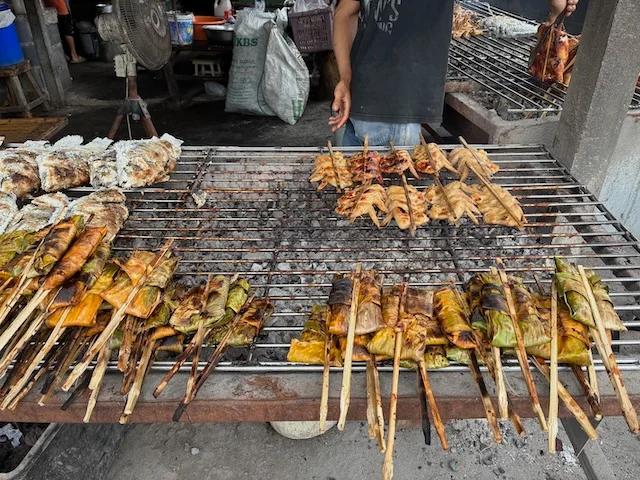
- All street food stalls (cash only)
- Markets such as Chatuchak, Rot Fai and night markets
- Tuk-tuks and plenty of taxis
- Small family-run restaurants and local eateries
- Massage parlours (excluding large hotel spas)
- Temples (admission fee)
- Small shops in non-touristy neighbourhoods
- Some bars and small pubs
Where you can use your debit card:
- Banks, shopping centres and large department stores
- Hotel chains and large hotels
- Larger restaurant chains and Western fast-food chains
- 7-Eleven, Family Mart en andere convenience stores
- Hospitals and clinics
- Larger massage chains such as Health Land
Our advice: Always carry at least 2,000–3,000 baht in cash for a day packed with activities. For a day spent visiting markets or sampling street food, allow for 3,000–5,000 baht.
Currency exchange: where can you get the best rate?
There are several ways to exchange euros/dollars/pounds for baht. Exchange rates can vary considerably, so it’s worth shopping around.
1. Currency exchange bureaux in Bangkok (best option)
Currency exchange bureaux, also known as ‘money exchange’ outlets, offer by far the best exchange rates. You can spot them by the signs displaying the exchange rates outside.
SuperRich This is the king of currency exchange bureaux, although there are two different chains:
- SuperRich Orange (orange logo)
- SuperRich Green (green logo, officially “SuperRich Thailand”)
Both are reliable and often offer the best exchange rates in Bangkok, sometimes even better than banks. You’ll find branches in major shopping centres, around Sukhumvit, and in Siam Square. Search on Google Maps for your nearest branch. For amounts over 10,000 baht, you’ll need your passport.
Other reliable currency exchange bureaux:
- Vasu Exchange
- Siam Exchange
- Value Plus
Tip: Check the exchange rates at several bureaux de change in the area, sometimes there’s a difference of a few tenths of a percent, which really makes a difference with larger amounts. The exchange rates are clearly displayed on signs outside, so you can easily compare them without having to go inside.
2. Banks (a reasonable option)
Thai banks such as Bangkok Bank, Kasikorn Bank (K-Bank) and Siam Commercial Bank also exchange money, but the rates are less favourable than at bureaux de change. The advantage is that banks are everywhere and are reliable. Do expect longer queues, especially at lunchtime (12 noon–1 pm).
3. Hotels (avoid)
Hotels do exchange money, but at the worst rates. Only use this service in an emergency, such as if you arrive late at night and have no other option. The difference can be as much as 5–10% compared to bureaux de change.
4. Suvarnabhumi Airport (emergency option)
There are several currency exchange bureaux at the airport, but the rates are worse than in the city. Only exchange enough here to cover your first day (500–1,000 baht for transport, a meal and possibly a SIM card). Exchange the rest later in the city at SuperRich.
Please note: SuperRich also has a branch at the airport (on the ground floor, near the Airport Rail Link), and it offers much better exchange rates than the standard bureaux de change in the arrivals hall!
5. In your home country (don’t do it)
You should hardly ever, if ever, exchange money in your home country. The exchange rates are terrible and you often have to pay a commission as well. It really isn’t worth it.
Withdrawing cash from ATMs: costs and tips
ATMs can be found everywhere in Bangkok, at every 7-Eleven, in every shopping centre, and on almost every street corner. They’re a handy way to get hold of cash, but the costs can really add up if you’re not careful.
The costs
Thai banks charge a fixed fee of 250 baht per withdrawal with a Visa card, and 350 baht with a Mastercard. It makes no difference whether you withdraw 1,000 or 20,000 baht. This applies at all the big banks (Bangkok Bank, Kasikorn, SCB, Krungthai, Krungsri and ttb); we checked the fees in September 2026. On top of that, you pay:
- The fees charged by your own bank (usually €2–€5 per withdrawal)
- Any exchange rate surcharge applied by your bank (1–3%)
Check which logo is on your debit card before you leave. Many banks have replaced Maestro with a Debit Mastercard (ABN AMRO, KBC and Belfius, for example), which means 350 baht per withdrawal. If you also have a Visa card, use that one at the ATM: it saves you 100 baht every time.
If you withdraw the equivalent of 100 euros, you’ll easily pay 10–15 euros in fees, and a few euros more with a Mastercard. That’s why it’s a good idea to:
Smart ATM strategies
1. Withdraw large amounts at once As the ATM fee is a fixed amount, it is better to withdraw 20,000 baht in one go than 5,000 baht four times. Most ATMs have a limit of 20,000–30,000 baht per transaction.
2. Use a good travel card Some banks charge low or no foreign transaction fees:
- Wise (good exchange rates, low fees), our favourite travel card
- Bunq (good exchange rate)
- Revolut (free withdrawals up to a certain amount per month)
Please note: you will still have to pay the Thai ATM fee of 250 or 350 baht, but you will save on your own bank charges.
3. Decline the ATM’s currency conversion This is crucial: many Thai ATMs offer to convert the amount into euros for you. This is known as “Dynamic Currency Conversion” (DCC). Always refuse this! The exchange rate offered by the ATM is much worse than what your own bank charges. Always choose to pay in local currency (baht).
If the ATM asks: “Accept the conversion?” or “Proceed with or without conversion?” – choose “WITHOUT conversion” or “Decline”.
4. Choose the right bank Not all Thai banks are equally user-friendly when it comes to foreign cards:
- AEON ATMs (purple logo): Usually cheaper, at around 150 baht per withdrawal instead of 250 or 350. They’re harder to find, though: look in supermarkets such as MaxValu, Lotus’s (formerly Tesco Lotus) and Big C. The fee appears on the screen before you confirm, so you always know what you’re paying.
- Bangkok Bank (blue): Reliable, with branches everywhere
- Kasikorn Bank (green): Good ATMs, clear instructions in English
- Siam Commercial Bank (purple): Also reliable
5. Security when using your debit card
- Use ATMs inside shopping centres or banks, not standalone machines on the street
- Cover the keypad when entering your PIN
- Don’t use your card late at night in deserted areas
- If the ATM looks suspicious or doesn’t return your card straight away, cancel the transaction
What if the ATM swallows your card?
This rarely happens, but it can happen. If your card gets stuck:
- Stay by the ATM
- Call the telephone number shown on the ATM straight away (there is always a service number)
- Or visit a branch of that bank the next working day with your passport
- Cards are usually returned within 1–2 working days

Credit cards and debit cards in Bangkok
Creditcards (Visa, Mastercard)
Credit cards are becoming increasingly widely accepted in Bangkok, particularly:
- Hotels (often require a deposit)
- Large restaurants
- Shopping centres and department stores
- Online bookings (tours, hotels)
- Luxury spas and hospitals
Common practice: Restaurants and hotels often charge a 3–5% surcharge for credit card payments. Ask about this in advance to avoid any surprises. You may even get a discount if you pay in cash.
Visa and Mastercard are the most widely accepted. American Express and Diners Club are accepted much less frequently.
Maestro and V-Pay
This is where things get complicated for travellers. Maestro is rarely accepted in Thailand. Some ATMs accept Maestro for cash withdrawals, but you’ll almost never be able to pay with Maestro in shops.
V-Pay often doesn’t work at all in Thailand because it was designed exclusively for Europe.
Solution: Before you leave, get a Mastercard or Visa (debit or credit) from your bank, or use a modern travel card such as Revolut or Wise.
The Travel Card
We ourselves have been using the Wise card in Thailand for years, both for payments in shopping centres, supermarkets, 7-Eleven (often with a minimum spend of 200 THB), hotels and larger restaurants, as well as for cash withdrawals at ATMs.

The biggest advantage of the Wise card in Thailand is that you pay at the mid-market rate, which means you avoid the unfavourable exchange rate mark-ups charged by traditional banks and can save up to 87% on conversion fees. The handy app sends you instant notifications and allows you to block your card immediately if it is lost.
Contactless and mobile payments
Bangkok is modernising rapidly, but contactless payment is not yet as widespread as it is in Europe.
PromptPay and QR codes In Thailand itself, mobile payments via PromptPay and QR codes are hugely popular. Locals scan QR codes everywhere to make payments. Unfortunately, as a tourist, you cannot use this system without a Thai bank account.
NFC/contactless Some modern shops, coffee shops (Starbucks, After You) and large chains accept contactless payments with your foreign card. But don’t count on it, always keep some cash to hand.
Budget planning: what does it cost in Bangkok?
To give you an idea of roughly how much you’ll be spending:
Food
- Street food: 40–80 baht per dish
- Local restaurant: 80–150 baht per meal
- Mid-range restaurant: 200–400 baht per person
- Upmarket restaurant: 800–2,000+ baht per person
- Bottle of water: 10–15 baht
- Thai coffee: 30–50 baht
- Starbucks: 100–150 baht
- A beer on the street: 50–70 baht
- A beer in a bar: 100–200 baht
Transport
- BTS/MRT: 16–59 baht per journey
- Chao Phraya boot: 15-40 baht
- Taxi (short journey): 50–100 baht
- Grab (average): 80–150 baht
- Tuk-tuk: 100–200 baht (haggle!)
Attractions
- Grand Palace: 500 baht
- Temples: 50–200 baht
- Massage (1 hour): 200–400 baht
- Rooftop bar: 300–600 baht per drink
Estimated daily budget
- Budget traveller: 1,000–1,500 baht per day (€25–40)
- Mid-range traveller: 2,500–4,000 baht per day (€60–100)
- Luxury traveller: 6,000+ baht/day (€150+)

Tipping: what are the rules of etiquette?
Thailand doesn’t have a tipping culture in the same way as the US, but tipping is becoming increasingly common in tourist areas.
Restaurants
- For good service: 10% or round up
- For excellent service: an extra 50–100 baht
- When buying street food: tips aren’t expected, but leaving some change is appreciated
Massage
- Standard: 50–100 baht for the masseur or masseuse
- For a special massage: 100–200 baht
Hotels
- Luggage porters: 20–50 baht per suitcase
- Room service: 20–50 baht
- Housekeeping: 20–50 baht per day (please leave on the pillow)
Transport
- Taxis/Grab: tips aren’t expected, but rounding up is appreciated
- Tuk-tuk: no tip (you’ve already agreed on a price)
How do you tip? Always give your tip directly to the person, not via a tip jar. In Thailand, it is polite to give a tip with both hands or with a small wai (bow). But as a tourist, simply handing it over in a friendly manner is perfectly fine.
Common money scams
Unfortunately, there are scammers who try to rip off tourists. Watch out for these scams:
1. The “closed temple” scam Friendly “helpers” at the Grand Palace will tell you it’s closed and try to take you to another attraction (where they get a commission). Ignore them, check for yourself at the entrance.
2. Fake masseuses at massage parlours Please note: not all “massage parlours” are legitimate. Check Google reviews and go to reputable chains such as Health Land or Let’s Relax.
3. Overpriced tuk-tuks Tuk-tuk drivers who approach you unsolicited at tourist spots often charge 5–10 times the normal price. Bargain hard or use Grab.
4. Taxis with ‘broken’ meters Taxis that refuse to switch on the meter are trying to rip you off. Get out and take another taxi. Or use Grab.
5. Exchange rate tricks Always check how many baht you’re getting for your euros and count the money before you leave. At smaller, unofficial bureaux, they may try to cheat you.
6. Rates that seem too good to be true If a currency exchange bureau offers a rate that is much better than the rest, it is often too good to be true. There are likely to be hidden costs or commissions involved.
Practical tips at a glance
✓ Exchange money at SuperRich for the best rate
✓ Take cash with you for your daily expenses
✓ Withdraw large amounts to minimise the ATM fee (250 baht with Visa, 350 with Mastercard)
✓ Decline currency conversion at ATMs – always pay in baht
✓ Get a good travel card, such as Wise before you leave
✓ Keep small notes (20, 50, 100 baht) to hand
✓ Budget 2,500–4,000 baht per day for a comfortable trip
✓ Download Grab for transparent transport prices
✓ Use a Visa card at the ATM if you have one: it’s 100 baht cheaper than a Mastercard
Frequently Asked Questions about Money Matters in Bangkok and Thailand
What is the official currency in Thailand?
The official currency is the Thai baht (THB). Banknotes are available in denominations of 20, 50, 100, 500 and 1,000 baht. It is a good idea to always carry small notes (such as 20 and 100 baht) for small purchases and transport.
Can I pay with my debit or credit card everywhere?
Credit cards (Visa/Mastercard) are widely accepted in large shopping centres, hotels and luxury restaurants. However, ‘cash is king’ in Bangkok and Thailand: you’ll definitely need cash for street food, local markets, tuk-tuks and small temples.
Where is the best place to exchange money?
For the best exchange rates, it’s best to visit specialist bureaux de change such as SuperRich (both the orange and green branches). Avoid exchanging money at hotels or banks in your home country, as the rates there are often unfavourable.
Why does the cash machine (ATM) charge an extra 250 or 350 baht?
All the big Thai banks charge a fixed fee for foreign cards: 250 baht per withdrawal with a Visa card and 350 baht with a Mastercard. To keep the cost down, withdraw larger amounts at a time (for example 10,000 or 20,000 baht) and use a Visa card if you have one. AEON ATMs are usually cheaper, at around 150 baht, but you won’t find them everywhere.
When using an ATM, should I select “With Conversion” or “Without Conversion”?
Always select “Without Conversion”. If you accept the machine’s conversion rate, the Thai bank will apply a very unfavourable exchange rate. By refusing it, you allow your own bank to handle the conversion, which is almost always cheaper.
Will my bank card (Maestro/V-Pay) work in Thailand?
Maestro is accepted by a limited number of ATMs, but hardly anywhere in shops. V-Pay often doesn’t work at all outside Europe. It is strongly recommended that you take a Visa or Mastercard (credit or debit card) or a travel card (Revolut, Wise). Don’t forget to switch your bank card to ‘World Profile’ before you leave!
How much is the usual tip in Bangkok?
Tipping is not compulsory, but it is greatly appreciated. In restaurants, you can tip around 10% or round up the bill if the service is good. For massages, a tip of 50 to 100 baht is customary, and for porters in hotels, around 20 to 50 baht.
What daily budget should I allow for?
This depends on your travel style:
- Budget: €25–€40 per day (street food and local transport).
- Mid-range: €60–€100 per day (restaurants, taxis and paid attractions).
- Luxury: €150+ per day (fancy dinners, rooftop bars and private guides).
How can I avoid paying too much for a taxi or tuk-tuk?
Always ask the taxi driver to turn on the meter (“Please use the meter”). If they refuse, get out. With tuk-tuks, you need to agree on a price in advance. A safe and transparent alternative is the Grab app (the Asian Uber), where the price is fixed in advance.

In conclusion
Managing your money in Bangkok and Thailand doesn’t have to be complicated. Make sure you carry enough cash, exchange money at reputable bureaux de change, and be smart about ATM withdrawals. With these tips, you’ll save hundreds of euros during your stay and avoid any nasty surprises.
Most importantly: relax and enjoy yourself. Bangkok is affordable, and with the right preparation, you can focus on what really matters, enjoying this amazing city!
TIP: Book your Bangkok hotel and your Bangkok excursions in advance whilst still in your country.
Khop khun ka/krap, have a great time in Bangkok and Thailand!
Ready to spend your budget wisely in the City of Angels?
Now that you know exactly the best ways to pay, use your debit card and save money in Bangkok, you’re all set for a carefree adventure. Whether you’re arriving with a well-stocked wallet for luxury dinners or prefer to stick to a tight budget at the local markets, Bangkok offers an unforgettable experience for every budget.
Time to book your ideal hotel! A savvy traveller doesn’t just look at the price, but also at the location. Do you want to be right in the heart of bustling Sukhumvit, or would you prefer a luxury hotel by the river where you can enjoy the most beautiful sunsets with the baht you’ve just withdrawn? The right base determines how you experience Bangkok.
Find the perfect match to suit your budget and travel style.
See the Best Hotels in Bangkok All Thailand Travel Tips